

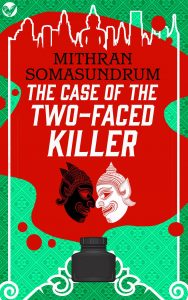
In The Case of the Two-Faced Killer, Mithran Somasundrum avoids all the seamy Bangkok cliches and the usual Thai stereotypes to draw blood from classic archetypes of the mystery genre mixed with contemporary settings and some blasts of Cambodian history.
Despite the book´s main setting in modern-day Bangkok, references to AI and Google searches, The Case of the Two-Faced Killer has all the hallmarks of a classic mystery: a suicide that might be foul play, exorbitant antiques that might be fake and/or part of a smuggling racket, the Venetian blinds in an office that the detective shares with a female assistant, a wisecracking PI whose sympathies lie with society´s outcasts but has the social panache, connections and intelligence to mingle with the elite, and his mounting sense of dread about a death which will catapult him into a wider investigation that involves much greater historical forces and higher financial stakes.
That said, the author adds plenty of new wrinkles to the complexion of this weathered yet still vital genre. For a detective, Vijay´s backstory is original. A one-time civil servant from England, who became an English teacher in Bangkok, he speaks the Queen´s English but looks Indian. His side hustle is translation work, which is drying up thanks to AI.

Book one in the series is also set in Bangkok.
In chapter one, where his ex-girlfriend, Malinee, is introduced, we learn a little about the first entry in the series, The Case of the Vanishing Con Man, another Bangkok-set mystery, which is enough of a primer for book two. We also learn about the apparent suicide of the antiques dealer.
Having lived and worked in Thailand for many years, and traveled widely in Cambodia, I am a stickler for accuracy when it comes to the complexities and nuances of these cultures. The author has also lived in Bangkok for decades, which allows him to bring an authenticity to the setting and different scenes, like a Thai cremation ceremony, where mourners pay tribute to the dead with one stick of incense instead of the three used for a normal blessing ceremony. I was also impressed by the hard-bitten realism of a scene in a construction site where Vijay interviews the workers from Cambodia, who dwell in a grey area between invisibility and illegality. This scene also serves double duty for introducing the reader to the first Khmer characters, who hail from a country rich in history, rife with poverty and lousy with corruption.
For the most part, the author stays away from too much fancy prose or drawing attention to the authorial voice behind the mystery, which makes for a breezy read. That is an accomplishment. Many writers think they have to prove they can really write by waxing extravagantly poetic at the expense of the story. As Nathaniel Hawthorne once remarked, “Easy reading makes for damn hard writing.”
At the same time, I enjoyed some of the book´s more poetic turns of phrase, such as the detective reminiscing about a murder scene, “Vijay had stood on the long empty road while the occasional motorbike rattled past and the night murmured, Now let us forget.” Or when the detective is standing outside an unfinished high-rise where a murder took place, “In his mind, it was like a negative lighthouse, shining a beam of shadow down the road.”
Some of the terse characterizations that also serve as scene-setting are bound to evoke some nods of recognition, like the part when the detective meets up with his ex and “The hot, close room filled with all Vijay’s regrets.” While reflecting on the marriage of Arthur Cavendish, the antiques dealer specializing in Khmer artefacts whose death triggers the investigation, Vijay reflects, “Very few marriages proved to be perfect if you scratched at the veneer for long enough.”
These descriptions and characterizations elevate the book above many standard-issue mysteries, which are long on plot and short on emotional wallop.

Author Mithran Somasundran has been based in Bangkok for decades. Look for book three in the Vijay series in 2027.
Sometimes the plot summaries on the back of a book can give away too many of the enigmas contained within the covers before they are revealed in due course. In the case of this slowly percolating potboiler, I was glad to know in advance that the mystery at the nucleus of the book leads all the way back to the genocidal Khmer Rouge regime, an ultra-Maoist group responsible for the deaths of as many as two million Cambodians through starvation, execution and overwork during the 1970s. In this dark light, which contradicts the description “escapist mystery” on the cover, I would say it is more of a “cold case historical investigation.”
Nevertheless, it is a shame that Vijay never visits Cambodia in the book. Known as “Scambodia,” the nation is far more lawless, corrupt and dangerous than Thailand. At least, through Vijay´s research and interview with Suttiporn, the novel offers a first-hand account of life under the regime and the squalor, deprivation and sexual violence of the refugee camps.
This chapter conjured an old memory of the infamous Khmer Rouge slogan: “The wheel of history is inexorably turning; he who cannot keep pace with it shall be crushed.”
That wheel travels in both directions. As the novel notes—and history confirms—many perpetrators of these atrocities never faced justice or retribution. Yet The Case of the Two-Faced Killer (the ebook is available from Amazon for US$3.99)) offers something of a reckoning, giving a voice to the survivors while restoring a measure of humanity to those who suffered from the unspeakable acts carried out by one of the twentieth century’s most brutal regimes, all within a mystery that balances heart with humour and action with suspense
Now I am hoping to devour the first book in the series and to ride shotgun on Vijay´s future adventures through the neon jungles, penthouses and backstreets of Bangkok.
(I received an ARC from Joffe Books, which did not vet or provide any input for this review.)
Jim Algie´s books set in Thailand are available from Amazon.
Recent Comments